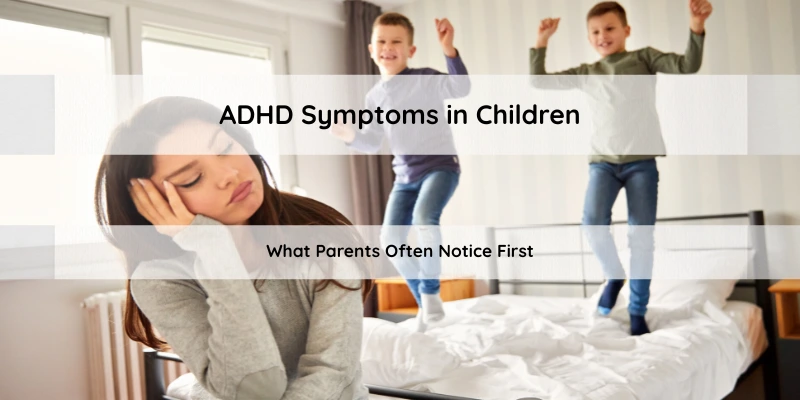
ADHD Symptoms in Children – What Parents Often Notice First
How ADHD Can Show Up in Everyday Childhood Behaviour
Parents often search for ADHD symptoms because something about their child’s behaviour feels different — but it’s hard to explain exactly why. Perhaps your child understands instructions but struggles to follow through. Maybe emotions escalate quickly, routines are exhausting, or daily tasks feel like an uphill battle despite effort and encouragement.
ADHD symptoms don’t always look like constant hyperactivity or obvious disruption. In many children, they appear as inconsistency, emotional intensity, mental overload, or difficulty translating intention into action. This article focuses on how ADHD-related symptoms commonly show up in real life, helping parents recognise patterns without jumping to conclusions or labels.
For a full overview of ADHD, including causes, types, diagnosis and support, see our page on ADHD in Children.
ADHD Symptoms Parents Often Notice First
One of the earliest signs parents report is not a lack of understanding, but a gap between knowing and doing. A child may know the rules, remember instructions when asked, and genuinely want to succeed — yet still struggle to carry tasks through.
This can look like:
- starting tasks but not finishing them
- forgetting steps moments after hearing them
- needing frequent reminders for routines
- losing items repeatedly despite effort
- becoming overwhelmed by simple requests
These patterns are often mistaken for laziness or defiance, but they reflect difficulty with executive functioning — the brain’s ability to organise, prioritise and sustain effort.
Attention Difficulties Are Not Always Obvious
ADHD-related attention difficulties are often misunderstood. Many children with ADHD can focus deeply on activities they find interesting or stimulating, such as games, building, drawing or screens. This can make parents question whether attention is really the issue.
The difficulty lies not in attention itself, but in regulating attention. Children with ADHD often struggle to shift focus, maintain effort during low-interest tasks, or divide attention across multiple demands. Activities that require sustained mental effort — like homework, listening, or organising belongings — are usually much harder than activities driven by interest or novelty.
Emotional Symptoms Are Common but Often Overlooked
One of the most significant — and frequently missed — ADHD symptoms is emotional dysregulation. Many children experience emotions quickly, intensely, and with little warning. Small frustrations can trigger big reactions, and calming down may take longer than expected.
Parents may notice:
- rapid mood shifts
- low frustration tolerance
- emotional outbursts followed by remorse
- strong reactions to minor setbacks
- sensitivity to perceived criticism or failure
These emotional responses are not manipulative or intentional. They reflect difficulty slowing emotional reactions once the nervous system is activated.
ADHD Symptoms Can Fluctuate
ADHD symptoms are rarely constant. Many parents notice that behaviour changes depending on context, energy levels, or emotional load.
Symptoms often intensify when a child is:
- tired or hungry
- overstimulated
- under pressure
- navigating transitions
- dealing with emotional stress
This variability can be confusing and may lead adults to assume the child is “choosing” when to struggle. In reality, stress places additional demands on executive functioning — the very area where ADHD brains are already working harder.
Social and Everyday Impacts
In social settings, ADHD symptoms can affect interactions even when a child wants to connect positively. Impulsivity may lead to interrupting, difficulty waiting, or reacting before thinking. Some children miss subtle social cues, while others become overwhelmed by the demands of group play.
At home, symptoms often show up during routines — mornings, homework time, transitions, or bedtime — when organisation, emotional regulation and sustained attention are required all at once.
Common Misinterpretations of ADHD Symptoms
ADHD symptoms are frequently misunderstood. Children may be described as:
- not trying hard enough
- careless
- oppositional
- overly sensitive
- inconsistent
In reality, many children with ADHD are trying harder than it appears. When effort doesn’t lead to success, repeated correction or criticism can impact confidence and self-esteem over time.
When ADHD Symptoms Raise Questions
Many ADHD-like behaviours can appear in typical development, especially during periods of growth or stress. However, it may be helpful to explore further if patterns:
- are persistent over time
- occur across multiple settings
- interfere with learning, relationships or wellbeing
- cause significant frustration or distress for the child
Recognising symptoms is not about diagnosing — it’s about understanding what support a child may need.
A Strength-Based Perspective
Children with ADHD often bring remarkable strengths, including creativity, curiosity, empathy, humour and original thinking. When their needs are understood and supported, these strengths are more likely to shine.
Understanding ADHD symptoms allows parents to move away from blame and toward compassion — asking not “What’s wrong with my child?” but “What does my child’s brain need to function at its best?”
Where to Go Next
If the patterns described here feel familiar, you may find it helpful to read our full guide on ADHD in Children, which explores how ADHD affects development, emotional regulation, learning and daily life — along with evidence-based supports that can help children thrive.
Leave a Reply