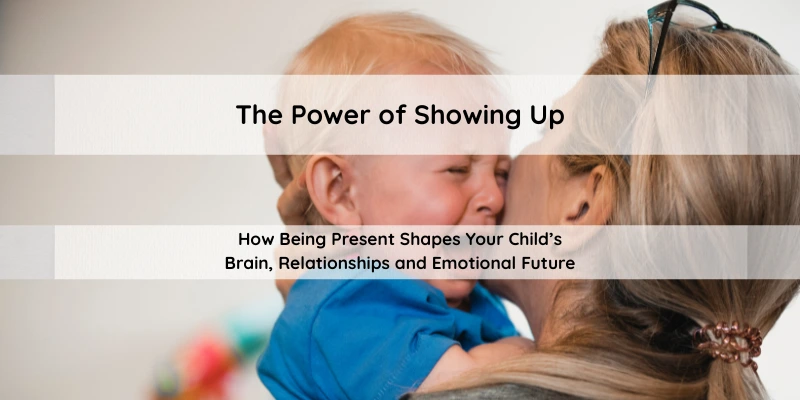
The Power of Showing Up – How Being Present Shapes Your Child’s Brain, Relationships and Emotional Future
Every parent wants to do what’s best for their child, yet modern parenting can feel overwhelming. With endless advice, competing expectations and the pressures of daily life, it’s easy to wonder whether you’re doing enough. Dr Daniel Siegel and Dr Tina Payne Bryson offer a reassuring message: you don’t need to be perfect — you just need to show up.
Their work demonstrates that when caregivers reliably show up for their children, they literally help shape healthier brains, stronger relationships and more resilient emotional lives.
What Does It Mean to “Show Up”?
In Siegel and Bryson’s framework, “showing up” is not about constant attention, flawless responses or being endlessly patient. Instead, it means offering four essential relational experiences — the Four S’s:
- Safe
- Seen
- Soothed
- Secure
These are not tasks to complete but ways of being with a child. When consistently offered, they create a foundation for lifelong confidence, emotional regulation and strong relationships. Showing up is about presence, not perfection.
Safe: Creating a Space Where Children Can Explore and Return
To feel safe, a child must experience two things:
- physical safety (protection from harm)
- emotional safety (protection from fear, shame or unpredictable reactions)
Children learn safety not just from the absence of threat but from the presence of a steady, regulating caregiver. A calm parent helps calm the child’s nervous system, especially during moments of distress or dysregulation.
When parents show up by providing safety, children begin to learn:
“I can explore the world because I’m not alone in it.”
Seen: Understanding the Inner Life of the Child
Being “seen” is more than noticing behaviour — it’s recognising the feelings, thoughts and needs beneath the behaviour.
Siegel calls this attuned communication: matching your emotional presence to your child’s state. You are not just watching your child; you are seeing into them — noticing the wobbling lip that means they’re about to cry, the silence that means they’re overwhelmed, or the enthusiasm that means they’re ready for connection.
When a child feels seen, they learn:
“My inner world matters. Someone understands me.”
This fosters empathy, self-awareness and emotional literacy.
Soothed: Helping Children Calm Their Bodies and Emotions
Children cannot self-regulate without first being co-regulated.
Their brains depend on the presence of a steady adult to learn how to move from distress back to calm. Soothing is not rescuing or fixing; it is supporting the child through the emotional storm.
Whether through a quiet voice, gentle touch, slow breathing or simple proximity, soothing teaches children that:
“Strong feelings are survivable — especially when someone helps me through them.”
Over time, these repeated experiences wire the brain toward internal regulation. Children gradually learn to soothe themselves because soothing was modelled and felt.
Secure: Building the Foundation of Secure Attachment
When a child feels safe, seen and soothed consistently, they develop secure attachment — the belief that the world is predictable, relationships are trustworthy and they themselves are worthy of care.
Secure attachment is not about flawless parenting. In fact, Siegel and Bryson emphasise that attunement happens only about 30 percent of the time in even the healthiest relationships. What matters most is repair — reconnecting after misattunements, misunderstandings or moments of frustration.
When parents show up reliably, children develop inner security:
“I can depend on you… and I can depend on myself.”
This security becomes the emotional blueprint they carry into friendships, learning environments and adult relationships.
Why Showing Up Matters for Brain Development
Neuroscience shows that repeated emotional experiences shape the architecture of the developing brain. When caregivers show up with consistency, warmth and presence:
- the child’s stress response system becomes more stable
- the prefrontal cortex (thinking brain) strengthens
- the limbic system (emotional brain) learns to regulate
- the child forms healthier attachment pathways
- neural integration improves, helping the child think, feel and act more flexibly
Showing up is not a soft skill — it is a neurobiological investment in a child’s future resilience.
You Don’t Need to Be Perfect — You Just Need to Be Present
One of Siegel and Bryson’s most reassuring messages is that ruptures are inevitable. You will have moments of impatience, distraction or emotional missteps. What matters is returning, reconnecting and showing your child that relationships can be repaired.
The power of showing up comes from presence, not perfection.
It is found in small moments: the pause before responding, the hug after the tears, the willingness to listen, or the gentle “I’m here” when emotions rise.
When parents show up again and again, children internalise this truth:
“I matter. I am loved. I am not alone.”
And that belief becomes a lifelong source of strength.
Child Behaviour Australia is proudly part of Child Care Guide
Leave a Reply