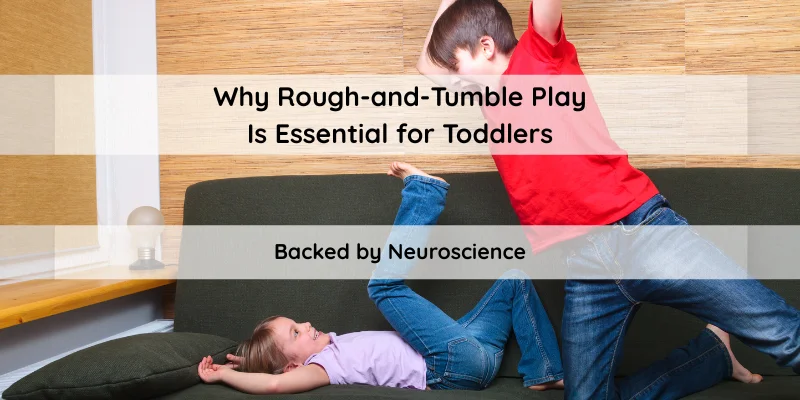
Many parents feel nervous when their toddler starts wrestling on the lounge room floor, climbing over Dad like a jungle gym, or squealing in a chaotic tangle of arms and giggles. It can look wild, unpredictable, or even risky.
But science is clear: rough-and-tumble play is one of the most important forms of play for young children.
This kind of active, physical play doesn’t just burn energy — it shapes social skills, emotional regulation, resilience, and even brain development. And a huge part of what we know today comes from the work of neuroscientist Jaak Panksepp, who discovered that play is not just a behaviour… it’s a built-in brain circuit shared across mammals.
The Mammalian “Play Circuit”: What Panksepp Discovered
Jaak Panksepp, a pioneer in affective neuroscience, identified seven primal emotional systems in the mammalian brain — things like SEEKING, CARE, FEAR, and PLAY.
In experiments with young mammals (like rat pups), he found that:
- Play is biologically programmed, not learned.
- Play activates specific subcortical neural networks associated with joy and social bonding.
- Rough-and-tumble play triggers laughter-like responses, such as the ultrasonic “chirping” rats make when tickled or wrestling — a direct sign of positive emotion.
- Depriving animals of play leads to social and emotional difficulties, including more aggression, poorer social negotiation, and higher stress responses.
In other words:
The need to play physically is built into the mammalian brain — toddlers included.
When your child tumbles, wrestles, climbs, rolls, or play-fights with you, they are activating ancient neural pathways designed to teach them how to socialise, regulate emotions, and understand boundaries.
Why Rough-and-Tumble Play Matters for Toddlers
1. It builds emotional regulation
Physical, exciting play helps toddlers experience big emotions in a safe context. They practice:
- Going “up” into excitement
- Coming “down” into calm
- Reading cues like “too rough” or “I need a break”
This helps wire the brain for self-control and emotional balance.
2. It teaches social boundaries and empathy
During rough play, toddlers learn:
- how to give and take
- how to read facial expressions
- how to pull back when someone says “stop”
- how to repair (“Sorry, that was too hard!”)
These moments strengthen the social parts of the brain and support later conflict-resolution skills.
3. It strengthens parent-child attachment
Rough play is usually full of eye contact, laughter, anticipation (“I’m gonna get you!”), and warmth. These interactions release oxytocin — the bonding hormone — deepening connection.
Some researchers describe rough play as a form of “joyful attachment work.”
4. It boosts motor skills and body awareness
Toddlers gain:
- balance
- coordination
- strength
- spatial awareness
This type of play challenges their body in ways ordinary activities don’t.
5. It reduces stress and supports mental health
Panksepp showed that activating the PLAY circuit makes animals more resilient to stress. The same is true for humans: active physical play drains anxiety, increases confidence, and releases feel-good neurotransmitters.
“But Won’t It Make Them Too Rough?”
Surprisingly, it’s the opposite.
Research shows that children who engage in regular rough-and-tumble play become less aggressive, because they develop:
- better impulse control
- clearer social boundaries
- stronger empathy
- more secure attachment
The absence of rough play — not the presence — is associated with higher aggression later in childhood.
How to Encourage Safe, Healthy Rough Play
Set simple safety rules
- “Stop when someone says stop.”
- “No hitting or face contact.”
- “Check in if someone looks upset.”
Join in when possible
Your presence increases safety and strengthens the benefits.
Use soft surfaces
Beds, cushions, mats, or grass are ideal.
Watch for over-stimulation
If the play gets too wild, help your child pause, breathe, and reset.
Follow your toddler’s cues
Some want big physical energy. Others prefer gentle wrestling. Both are valid.
A Helpful Way to Think About It
Rough-and-tumble play is not chaotic behaviour — it’s brain-building behaviour.
It activates deep, evolution-designed neural systems that help children grow into socially aware, emotionally balanced, resilient human beings.
When toddlers wrestle and laugh with you, they’re not “being silly.”
They’re wiring their brains for the future.
Leave a Reply