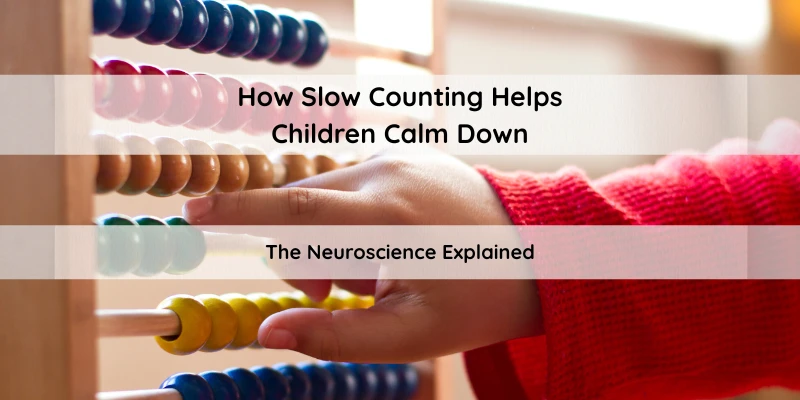
When a child is overwhelmed, melting down, or suddenly “losing it,” parents often hear advice like “help them count to ten.”
It sounds simple — almost too simple.
But slow counting (especially when combined with touching or moving physical objects like blocks or coins) has a powerful neurological basis. It can help a child’s brain shift out of emotional chaos and back into calm.
To understand why it works, we need to look at what actually happens during an amygdala hijack.
What Is an “Amygdala Hijack”?
The term amygdala hijack was coined by psychologist Daniel Goleman to describe what happens when the emotional part of the brain takes over.
Here’s how it works:
1. A child perceives a threat or becomes overwhelmed
This can be anything: losing a toy, transitions, sensory overload, frustration, or conflict.
2. The amygdala (the brain’s alarm system) reacts instantly
It floods the body with stress chemicals (adrenaline, cortisol) preparing the child for fight, flight, or freeze.
3. The frontal cortex — the “thinking brain” — goes offline
This is the part responsible for logic, reasoning, planning, and emotional regulation. During an amygdala hijack, it becomes much harder for a child to:
- listen
- problem-solve
- follow instructions
- make rational choices
Your child is not “misbehaving” — their brain is overwhelmed and temporarily unable to access its calm, organised functions.
How Slow Counting Helps: It Recruits the Frontal Cortex
Slow, deliberate counting is one of the fastest ways to interrupt an amygdala hijack.
Here’s the neuroscience:
1. Counting requires executive functioning
Numbers, sequences, and working memory live in the prefrontal cortex.
When a child begins counting, even very slowly:
- they shift blood flow from the emotional centres
- they activate logical, sequential thinking
- they “wake up” the executive system
This creates a physiological tug-of-war that helps pull the brain out of the emotional alarm state.
2. Physical counting objects increases regulation
When children count coins, blocks, beads, buttons, leaves — anything they can touch — the effect becomes even stronger.
Why?
Because this activates multiple calming systems at once:
- Touch input stimulates sensory pathways that reduce stress
- Visual focus reduces external chaos
- Rhythmic movement lowers arousal
- Sequencing numbers recruits the frontal cortex
This combination is a powerful grounding technique often used in mindfulness, trauma therapy, and occupational therapy.
3. Slow timing activates the parasympathetic nervous system
When children count slowly — “one… two… three…” — their breathing automatically slows.
Slow breathing activates the parasympathetic (rest-and-digest) system, lowering heart rate and reducing the intensity of the fight-or-flight response.
Why Slow Counting Works Better Than “Calm Down!”
Telling a child to “calm down” assumes that they still have access to logic.
During an amygdala hijack, they don’t.
Slow counting:
- gives the brain a job
- interrupts the emotional “alarm”
- restores access to thinking
- helps the body shift out of stress
- reduces the intensity and duration of meltdowns
It’s not a distraction — it’s neurological reset.
How to Use Slow Counting With Children
1. Model it during calm moments
Practice counting together when the child is not overwhelmed, so the strategy becomes familiar.
2. Pair counting with objects for best results
Try any small collection:
- coins
- LEGO bricks
- shells
- beads
- blocks
- pom-poms
- small toy cars
Ask: “Let’s count these slowly together.”
3. Go very slowly
Stretch each number. This naturally slows breathing.
4. Keep your tone low and steady
Your calm nervous system helps regulate theirs (co-regulation).
5. Stop when the child shows signs of settling
The goal is not to finish the count — it’s to restore access to the thinking brain.
A Simple Way to Explain It
When a child is overwhelmed:
- the emotional brain takes over
- the thinking brain goes offline
Slow counting is like pressing a reset button, helping the frontal cortex “come back online” and regain control.


Leave a Reply